Distributed training
gpubridge
One PyTorch training job across NVIDIA and AMD GPUs.
- In development
- v0.4.0-alpha
- Ranked 4 of 13
Screenshot. The sidebandstudio/gpubridge repository on GitHub, with its files and About panel
Overview
A PyTorch install is either a CUDA build or a ROCm build, and an NCCL communicator cannot exchange data with an RCCL one. gpubridge is for clusters that have both kinds of GPU and want one job to use them together, on stock PyTorch builds over any network. It writes no CUDA or HIP code and composes collectives PyTorch already provides.
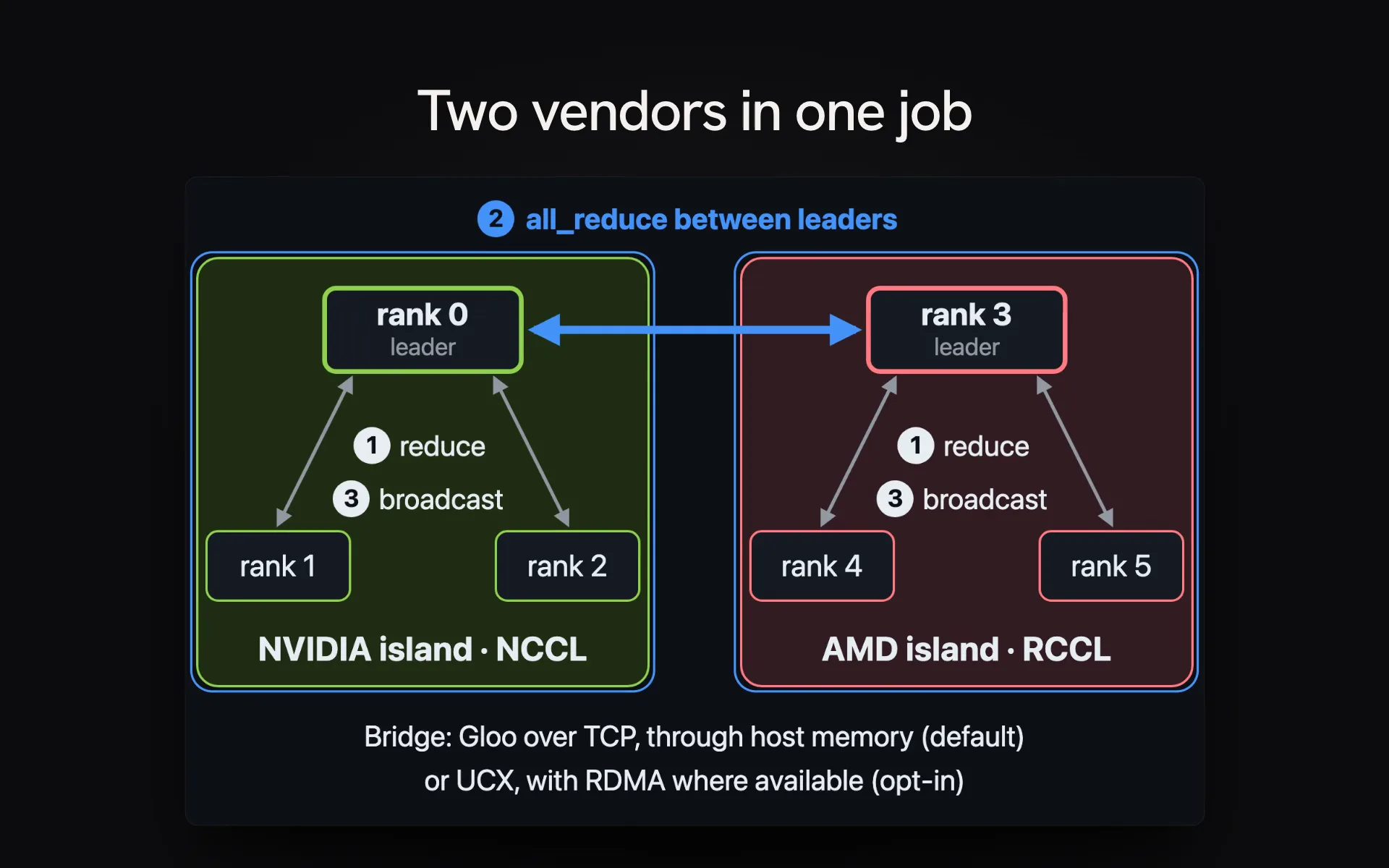
Each process detects its vendor from its PyTorch build. Ranks of one vendor form an island on the native library, led by its lowest rank. An all_reduce reduces within each island onto the leader, the leaders all_reduce over the bridge, Gloo over TCP through host memory by default, and each leader broadcasts the result back to its island. With one vendor there is no bridge and every call goes straight to NCCL or RCCL.
It is an alpha, installed from a GitHub release tag and not on PyPI. It has run alone on NVIDIA V100, T4, L40S, A100 and H200 GPUs and an AMD MI50, in mixed jobs of one V100 and one MI50 over TCP, and as two islands on one node of four V100s. Verbs between machines, GPU memory sent straight to the network card and jobs of more than four GPUs have not run yet.
What it does
Diagram. An NVIDIA island on NCCL and an AMD island on RCCL, each led by its lowest rank, with the three steps of an all_reduce across the bridge
Two vendors in one job
Each vendor’s ranks stay on NCCL or RCCL, and only the island leaders cross the bridge.
Diagram. A 2 by 4 device mesh whose shard groups are the NVIDIA and AMD islands, with one replicate all_reduce a step across the bridge
HSDP inside each vendor
With the shard groups set to the vendor islands, all-gathers and reduce-scatters stay native, and one all_reduce a step crosses the bridge.
Diagram. Loss over 1,000 steps for GPipe and 1F1B across a V100 and an MI50, against four runs on one V100
Pipelines across vendors
PyTorch’s own pipelining trains a LLaMA-style model with stage 0 on a V100 and stage 1 on an MI50. After 1,000 steps the 1F1B run’s loss was 1.801, against 1.800 to 1.809 on one V100.
Diagram. Loss over 200 steps for Megatron-Core in one stage on a V100 (pp1) and in two stages on a V100 and an MI50 (pp2), the two curves on top of each other
Megatron-Core without a patch
Megatron-Core’s own 1F1B schedule ran with one stage on a V100 and one on an MI50. Its loss stayed within 1.3e-4 of the V100 alone over 200 steps, at 17,057 tokens/s against 14,990.
Diagram. Loss over 1,000 steps for DDP on a V100 and an MI50, uncompressed and with bf16 and fp8 on the bridge, against four runs on one V100
Bridge compression
Opt-in fp8 or bf16 sends fewer bytes over the bridge. On a V100 and an MI50, fp8 raised DDP training from 4,549 to 9,523 tokens/s. It changes results, so it is off by default.
Screenshot. The simulate_two_islands example in a terminal: two NVIDIA and two AMD ranks on one CPU, every rank ending with 10.0
Simulation on a CPU
Set GPUBRIDGE_VENDOR on each process and the whole code path runs on one CPU, with Gloo standing in for NCCL and RCCL.
Also in gpubridge
A torch.distributed backend
Change the backend name to gpubridge and import it, and DDP and FSDP2 scripts run across vendors. Both trained on a V100 and an MI50.
Swappable bridges
Gloo is the default. Opt-in UCX, multi-stream TCP and raw InfiniBand verbs bridges plug into the same contract. On one node of four V100s, in loopback, verbs ran 1.7 to 3.1 times as fast as Gloo from 1 to 256 MiB in two runs, and slower up to 64 KiB.
One error on every rank
If any rank has no GPU, no NCCL or a bad device index, init() raises the same error on every rank instead of leaving the rest waiting.
More screenshots
1 screenshot of gpubridge.
Screenshot. The gpubridge repository on GitHub on a phone
By the numbers
From sidebandstudio/gpubridge on GitHub, synced Nov 4, 2026.
- Stars
- 0
- Forks
- 1
- Release downloads
- 0
- Commits
- 490
- Contributors
- 2
- Code
- 2.8 MB
Languages
- Python66.8%
- Rust23.4%
- Shell6.1%
- C1.7%
- Other2.0%
Contributors


Repository
- Latest release
- v0.4.0-alpha, Oct 13, 2026
- Releases
- 4
- Created
- Oct 6, 2026
- Last push
- Oct 21, 2026
- License
- MIT License
- Open source
- Yes
- Ranking
- 4 of 13, score 0.38
- Synced
- Nov 4, 2026